


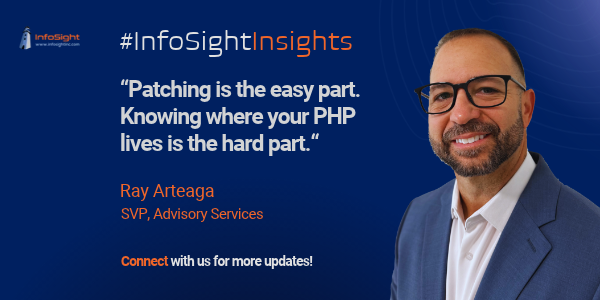
The PHP Flaws Are Patched. Your Exposure Isn't (Yet).
By Ray Arteaga, Senior Vice President, Advisory Services, InfoSight
InfoSight has helped manufacturers, financial institutions, and healthcare organizations through events like this since 1998, and the pattern is always the same. The organizations that come out fine aren't the ones that patch fastest. They're the ones that already knew what they owned. Here's how to protect yourself this week, and how to be ready for the next one.
1. Find every PHP instance you own, including the ones you forgot
You can't patch what you don't know about. Your main website is the obvious one. The risk usually sits somewhere else:
- Marketing microsites and campaign landing pages built by an agency years ago
- WordPress, Drupal, Joomla, or Magento installs (all PHP under the hood)
- Customer and patient portals, payment pages, and online forms
- Internal tools: intranets, help desks, wikis, and admin dashboards
- Vendor appliances and web consoles that ship with PHP built in
- Dev, staging, and test servers that someone left open to the internet
Don't stop at an internal spreadsheet. Scan your external attack surface the way an attacker would, then compare the results to what you thought you had. The difference between those two lists is your real exposure.
For each instance, write down three things: the PHP version, who owns it, and whether it faces the internet. Internet-facing systems get fixed first.
2. Patch fast, and have a plan for what you can't patch
Apply the official PHP security updates to every supported instance now. Measure this in hours, not your normal monthly maintenance window.
Then comes the uncomfortable part. Many organizations run PHP versions that are past end-of-life and no longer get security fixes. Cisco Talos estimates about half of internet-facing PHP instances are too old to take these patches. If one of those is yours, you have three options:
1Upgrade to a supported PHP version. This is the only permanent fix, and it may break older code, so test it.
2. Isolate the system behind compensating controls (next section) while the upgrade happens.
3. Take it offline until it's fixed. Several national cyber agencies advised exactly this.
"We'll leave it up and watch it" is not on the list. An unsupported, internet-facing server with a known remote code execution flaw will get found.
3. Buy time with compensating controls
When a patch can't land right away, reduce the ways an attacker can reach the flaw:
- Turn on web application firewall (WAF) protections. Cloudflare has already pushed rules for this flaw; ask your WAF provider what it has done. Confirm they're enabled and in blocking mode, not just logging.
- Limit request sizes. The flaw is triggered by oversized HTTP requests. Tighten request-size limits at the load balancer or web server to the smallest value your application can live with.
- Restrict access. If an admin panel or internal tool doesn't need to be public, put it behind a VPN or an IP allow-list today.
- Segment the server. Make sure a compromised web server can't reach your databases, file shares, or production network. The NSA warns these flaws often lead straight to a server's file system or database.
These controls buy you time. They don't replace the patch.
4. Assume someone already tried, and go look
Researchers have reported exploitation attempts and in-the-wild exploits. If an internet-facing PHP server sat unpatched after the flaws became public, treat it as possibly compromised until you've checked. Look for:
- Repeated PHP process crashes or out-of-memory errors in your logs
- Unusually large or malformed HTTP requests hitting your web servers
- New or changed files in web directories, especially PHP files you didn't deploy (a common sign of a web shell)
- New admin accounts, scheduled tasks, or outbound connections from the web server
- Unexpected queries against databases the site connects to
Patching closes the door. It does nothing about an attacker who already walked through it. If you find signs of compromise, isolate the server, preserve the logs, and bring in your incident response team before you rebuild.
5. Don't forget the PHP you don't host
A lot of your exposure runs on someone else's servers. Your hosting provider, your website agency, your SaaS vendors, and your partners' portals may all run PHP. Their breach can become your breach, especially when they hold your customer, patient, or financial data.
Send a short, direct note to each critical vendor this week:
- Do you use PHP in any system that stores or processes our data?
- Have you applied the October 2026 PHP security updates? If not, when?
- Are any of those systems on an end-of-life PHP version?
- Have you seen any signs of exploitation?
For regulated industries, keep the answers. If an examiner or auditor asks how you handled this event, you'll want proof that you checked on third parties, not just a vendor management policy on file.
The bigger lesson: your patch window is shrinking
One of these flaws was found with help from an AI model. As researcher Nicholas Weaver noted, AI is also good at turning a published patch into a working exploit. The time between "fix released" and "attacks begin" used to be weeks. Plan for it to be days or hours.
That changes what being prepared means:
• Know your assets before the next advisory. An up-to-date inventory of internet-facing systems, with versions and owners, turns a crisis into a checklist.
• Retire end-of-life software on a schedule. Every unsupported system is a future emergency you already know about.
• Have an emergency patch process. Decide now who can approve an out-of-cycle patch or take a site offline, so nobody waits for a meeting.
• Watch continuously. Detection catches what slips through while you patch.
AI has made attackers faster. Defenders need the same speed, with experienced analysts checking the results.
That's the "Powered by AI, Fueled by Experts" model in practice.
Not sure where your PHP exposure stands?
InfoSight can help you find internet-facing PHP systems, see which ones are unpatched or end-of-life, and check for signs of compromise. Our Mitigator® platform and security team give you a prioritized view of what to fix first. Talk to an InfoSight expert →
About the author: Ray Arteaga is CISO and Senior Vice President of Advisory Services at InfoSight, with more than 30 years of IT and cybersecurity experience in banking, healthcare, and retail. He directs InfoSight’s security assessments, IT risk evaluations, penetration testing, and compliance work across FFIEC, NIST, and PCI DSS, and oversees the Security Operations Team. He holds the CISA, CEH, and CHFI certifications, and his guiding principle is “Get it right the first time.”
Source: Cybersecurity Dive: critical PHP vulnerabilities (CVE-2026-109618, CVE-2026-109619)
Stay ahead of evolving threats with expert insights
Subscribe to our newsletter to keep you updated on the latest cybersecurity insights & resources.
One follow-up from a security expert—no spam, ever.