
Attackers Are Abusing Microsoft Teams and Quick Assist, What It Means for Enterprise Security
May 5, 2026 Newsletter

Attackers Are Abusing Microsoft Teams and Quick Assist, What It Means for Enterprise Security
A new wave of cyberattacks is exposing a structural weakness in modern security programs: trusted collaboration tools are now primary attack vectors.
Recent campaigns show attackers impersonating IT helpdesk personnel through Microsoft Teams and convincing employees to grant remote access via Quick Assist—turning legitimate tools into entry points for full network compromise.
This is not a vulnerability problem. It is an access control and trust exploitation problem.
How the Attack Works
The attack chain is simple, scalable, and highly effective:
Initial contact via Microsoft Teams
Attackers initiate chats or calls from external tenants, posing as internal IT or support staff.
Social engineering and urgency
Victims are told there is an issue (spam, account compromise, system error) requiring immediate action.
Remote access via Quick Assist
Users are guided to launch Quick Assist, granting full remote control of their device.
Post-access exploitation
Attackers use legitimate admin tools to move laterally, escalate privileges, and exfiltrate data—often blending into normal IT activity.
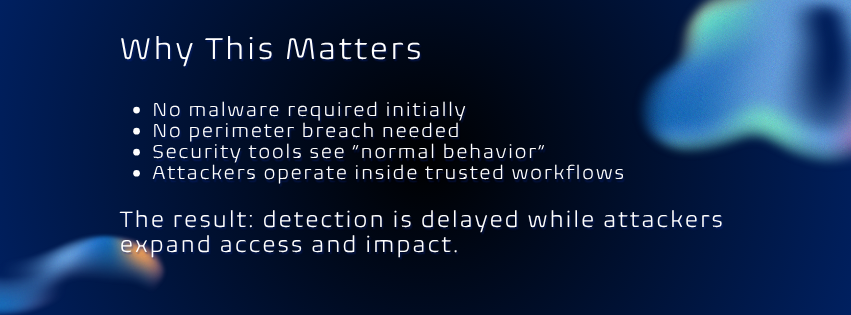
This model bypasses traditional defenses because no exploit is required. The user authorizes the attack.
Real-World Use Case Scenarios
1. Healthcare System: Clinical Disruption via Remote Access
Scenario
A hospital employee receives a Microsoft Teams message from “IT support” regarding email issues. They are instructed to open Quick Assist. The attacker gains access, pivots into clinical systems, and disrupts EHR access.
Impact
Delayed patient care
Ambulance diversion
Exposure of PHI
Regulatory consequences (HIPAA)
InfoSight Solution
Continuous monitoring of collaboration platforms (Teams telemetry)
Detection of anomalous remote access sessions
Identity-based risk scoring tied to clinical systems
Rapid containment through SOC-led incident response
2. Financial Institution: Credential Theft and Lateral Movement
Scenario
A senior executive is targeted via Teams impersonation (high-value targets are increasingly prioritized).
After granting access, attackers harvest credentials and move laterally into core banking systems.
Impact
Unauthorized transactions
Exposure of financial data
Compliance violations (FFIEC, GLBA)
Reputational damage
InfoSight Solution
Identity-centric threat detection (privileged account monitoring)
Behavioral analytics to detect abnormal admin activity
Risk quantification (financial exposure tied to compromised assets)
Purple Team simulation to test social engineering resilience
3. Manufacturing / OT Environment: IT-to-OT Pivot
Scenario
An employee in a manufacturing firm grants Quick Assist access. The attacker moves from IT systems into OT networks due to weak segmentation.
Impact
Production downtime
Equipment disruption
Supply chain delays
Safety risks
InfoSight Solution
OT/IT segmentation validation aligned to IEC 62443
Detection of lateral movement across zones and conduits
Continuous Threat Exposure Management to identify high-risk pathways
Prioritized remediation based on operational impact
4. Mid-Market Enterprise: Data Exfiltration Without Detection
Scenario
Attackers gain access via Teams, install legitimate file transfer tools, and exfiltrate sensitive data to cloud storage.
Impact
Intellectual property theft
Client data exposure
Legal and financial consequences
Because attackers use trusted tools, activity blends into normal operations.
InfoSight Solution
Detection of “living off the land” techniques
Monitoring for abnormal data movement patterns
Risk dashboards translating exposure into business impact
Executive-level reporting for rapid decision-making
Where Most Security Programs Fail
These attacks succeed because organizations:
Trust internal collaboration tools implicitly
Lack visibility into identity-driven access
Do not monitor remote support tools as attack vectors
Measure vulnerabilities—but not exposure pathways
The failure is not technical capability. It is operational visibility and prioritization.
InfoSight’s Approach: Controlling Exposure, Not Just Threats
InfoSight addresses this class of attack by focusing on exposure management and operational execution:
1. Identity-Centric Visibility
Track how access is granted, used, and abused across systems—not just whether vulnerabilities exist.
2. Continuous Threat Exposure Management
Quantify risk in financial terms and prioritize remediation based on impact, not severity scores.
3. Human-Led AI SOC (Purple Team Model)
Red Team: anticipates attacker behavior (social engineering, impersonation tactics)
Blue Team: detects and responds in real time
AI: accelerates detection, but human analysts validate and act
4. Remote Access Governance
Monitor tools like Quick Assist as high-risk entry points
Detect abnormal session initiation and usage patterns
Enforce policy-based restrictions and verification workflows
Key Takeaway
This attack trend proves a shift in cyber risk:
Attackers no longer need to break in
They convince users to let them in
Security programs that focus only on vulnerabilities will miss this.
Security programs that measure exposure, access, and behavior will stop it.
Stay ahead of evolving threats with expert insights
Subscribe to our newsletter to keep you updated on the latest cybersecurity insights & resources.
One follow-up from a security expert—no spam, ever.