
CISA Confirms Active Exploitation of Cisco SD-WAN Vulnerabilities
May 5, 2026 Newsletter

CISA Confirms Active Exploitation of Cisco SD-WAN Vulnerabilities
Recent alerts from Cybersecurity and Infrastructure Security Agency (CISA) confirm active exploitation of multiple vulnerabilities impacting Cisco SD-WAN infrastructure—systems that sit at the core of enterprise connectivity.
This is not another patch cycle issue. It exposes a structural failure in how organizations secure network control planes, identity access, and API-layer exposure.
What’s Actually Happening
CISA and partners identified multiple vulnerabilities in Cisco SD-WAN environments that are already being exploited in the wild.
Key attack paths include:
Unauthorized file access → credential compromise
Attackers can retrieve password files and authenticate into systems.
API abuse → system manipulation
Even low-privilege or read-only access can be leveraged to overwrite system files.
Unauthenticated data exposure → reconnaissance at scale
Poor access controls allow attackers to extract sensitive system data without logging in.
Credential leakage → lateral movement
Exposed credential files enable privilege escalation and deeper network compromise.
Authentication bypass (critical cases)
Some vulnerabilities allow full administrative access without credentials.
The result: control over the SD-WAN fabric, which directly impacts routing, segmentation, and enterprise-wide connectivity.
Why This Matters: SD-WAN Is a Force Multiplier
SD-WAN is not an edge device. It is the central nervous system of modern distributed enterprises.
When compromised:
Traffic routing can be manipulated
Segmentation controls can be bypassed
Remote sites become exposed simultaneously
Identity and access boundaries collapse
This shifts risk from isolated compromise → systemic exposure across the entire network fabric
Real-World Use Case Scenarios
1. Healthcare System: EHR and Clinical Network Disruption
Scenario:
A hospital system using SD-WAN to connect clinics, imaging systems, and EHR platforms is compromised via an exposed API vulnerability.
Attack chain:
Attacker retrieves credential file
Gains admin access to SD-WAN controller
Alters routing between clinical systems
Causes latency, outages, or misrouted traffic
Impact:
EHR access disruptions
Delayed patient care
HIPAA exposure across multiple facilities
InfoSight Response:
Continuous monitoring of SD-WAN control plane activity
Detection of anomalous routing or API behavior
Rapid containment via incident response playbooks
Quantification of operational risk impact (downtime cost, patient impact)
2. Financial Institution: Network Segmentation Bypass
Scenario:
A bank relies on SD-WAN segmentation between customer-facing systems and internal financial infrastructure.
Attack chain:
Exploit API flaw to overwrite system configuration
Modify segmentation policies
Gain access to restricted internal systems
Impact:
Unauthorized access to financial systems
Regulatory exposure (FFIEC, PCI DSS)
Potential fraud pathways
InfoSight Response:
Continuous validation of segmentation integrity
Risk scoring tied to exposure of high-value assets
Real-time alerting on policy drift or configuration changes
Executive-level reporting on financial risk exposure
3. Manufacturing / OT Environment: Plant-Wide Disruption
Scenario:
A manufacturer uses SD-WAN to connect IT systems with OT environments across plants.
Attack chain:
Authentication bypass grants admin access
Attacker injects malicious routing rules
OT systems become reachable from IT network
Impact:
Production downtime
Safety risks
Supply chain disruption
InfoSight Response:
OT-aware monitoring aligned to ISA/IEC 62443 zones and conduits
Detection of unauthorized cross-zone communication
Rapid isolation of compromised network segments
Exposure-based prioritization to protect critical production systems
4. Multi-Site Enterprise: Credential Reuse and Lateral Movement
Scenario:
An enterprise exposes SD-WAN management interface to the internet.
Attack chain:
Attacker extracts credential file (CVE-2026-20128)
Reuses credentials across systems
Moves laterally into cloud and identity infrastructure
Impact:
Identity compromise (Active Directory / Entra)
Cloud environment exposure
Enterprise-wide breach
InfoSight Response:
Identity-driven threat detection integrated with network telemetry
Correlation of credential misuse across environments
Continuous threat exposure management to identify blast radius
Quantification of risk concentration across identities and systems
Where Most Security Programs Fail
The common breakdown is not lack of tools. It is lack of operational visibility and prioritization.
Organizations typically:
Patch reactively without understanding exposure
Monitor endpoints but ignore control planes
Track vulnerabilities but not risk concentration
Miss API-layer and identity-driven attack paths
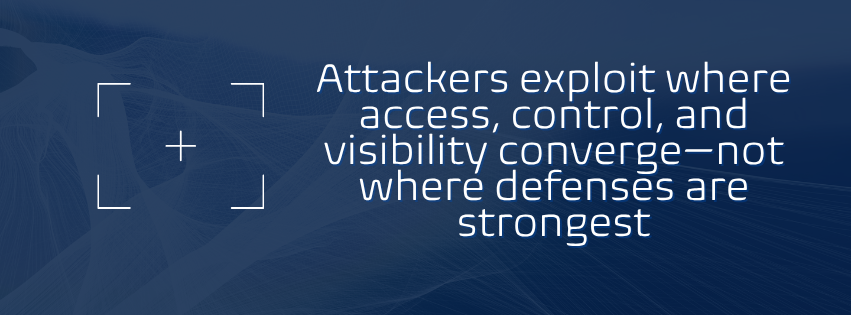
CISA’s warning reinforces a consistent pattern:
How InfoSight Solves This Problem
1. Continuous Threat Exposure Management
Maps vulnerabilities to real business impact
Identifies which systems drive the highest risk
Prioritizes remediation based on exposure, not volume
2. 24×7 Human-Led SOC + AI Enablement
Detects abnormal SD-WAN behavior, API misuse, and lateral movement
Combines automated detection with analyst validation
Reduces dwell time and accelerates containment
3. Identity + Network Correlation
Links credential exposure to network access pathways
Detects when authentication anomalies translate into system compromise
4. Quantitative Risk Intelligence (Mitigator Platform)
Converts technical vulnerabilities into financial exposure
Enables executive decision-making with measurable impact
Tracks remediation effectiveness over time
5. Incident Response Integration
Immediate triage, containment, and remediation
Playbooks tailored to network infrastructure attacks
Full lifecycle response from detection to recovery
Strategic Takeaway
This is not a Cisco problem. It is an architecture problem.
When:
Control planes are exposed
APIs are insufficiently secured
Credentials are stored or reused improperly
Risk becomes non-linear and systemic.
The shift required is clear:
From:
Vulnerability management
To:
Exposure management tied to business impact
Because in modern environments, compromise does not stay contained.
It propagates across identities, systems, and operations at scale.
Stay ahead of evolving threats with expert insights
Subscribe to our newsletter to keep you updated on the latest cybersecurity insights & resources.
One follow-up from a security expert—no spam, ever.