
Vercel Breach Exposes the Real Risk of AI Supply Chains — and What Organizations Must Do Next
May 5, 2026 Newsletter

Vercel Breach Exposes the Real Risk of AI Supply Chains — and What Organizations Must Do Next
The recent breach involving Vercel is not an isolated incident. It is a structural failure in how modern organizations integrate AI tools into their environments.
The attack did not begin with Vercel’s infrastructure. It began with a compromised third-party AI tool—Context.ai—that had been granted broad access into corporate systems.
Once attackers gained access, they moved laterally through OAuth permissions, compromised a corporate account, and pivoted into internal systems—ultimately exposing environment variables and credentials.
This is not a vulnerability problem. It is an exposure problem.
What Actually Happened
A third-party AI tool was compromised
That tool had excessive OAuth permissions into corporate systems
Attackers hijacked a user identity via Google Workspace
They moved laterally into internal environments
Environment variables and credentials were accessed and used for further expansion
This pattern reflects a growing category of AI-driven supply chain attacks, where trust—not code—is the initial attack vector.
Why This Matters for Enterprise Security
Most organizations still operate under outdated assumptions:
“Internal systems are trusted”
“Third-party tools are low risk”
“Credentials are secure if encrypted at rest”
The Vercel breach disproves all three.
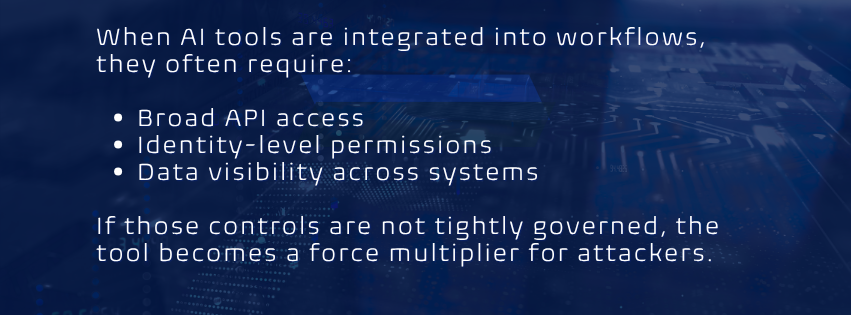
If those controls are not tightly governed, the tool becomes a force multiplier for attackers.
Real-World Use Case Scenarios
1. Healthcare: EHR Vendor Integration Compromise
Scenario:
A hospital integrates an AI assistant to streamline clinical documentation. The tool is granted access to EHR systems and identity services. The vendor is compromised.
Impact:
Unauthorized access to patient records
Lateral movement across hospital systems
Disruption to care delivery
How InfoSight Solves This:
Identity-based exposure mapping across EHR ecosystems
Continuous monitoring of third-party access pathways
Risk quantification tied to patient safety and operational downtime
2. Financial Services: Third-Party AI Risk in Customer Platforms
Scenario:
A bank deploys an AI tool for fraud detection, integrated with customer data systems and APIs. The tool is compromised via OAuth token theft.
Impact:
Exposure of financial data
Unauthorized transactions or system manipulation
Regulatory and compliance violations (FFIEC, GLBA)
How InfoSight Solves This:
Continuous Threat Exposure Management (CTEM) across identity and API layers
Quantification of financial risk exposure (ALE-based modeling)
Real-time prioritization of vulnerabilities based on business impact
3. Manufacturing / OT: AI Tool Bridging IT and OT Environments
Scenario:
A manufacturer uses AI analytics to optimize production systems. The AI platform connects to both IT networks and OT systems.
Impact:
Entry point into OT network via IT compromise
Production disruption or shutdown
Safety risks and operational downtime
How InfoSight Solves This:
OT risk segmentation aligned to ISA/IEC 62443
Detection of cross-zone exposure between IT and OT
Continuous validation of remediation and risk reduction
4. SaaS / Tech Companies: Environment Variable Exposure
Scenario:
A SaaS company uses multiple AI productivity tools connected to cloud environments. One integration is compromised.
Impact:
Exposure of API keys and deployment tokens
Unauthorized access to customer environments
Downstream supply chain risk affecting customers
How InfoSight Solves This:
Exposure concentration analysis (which assets drive the most risk)
Monitoring of environment variables and credential sprawl
MTTR tracking to reduce exposure windows
The Core Problem: Uncontrolled Access + Invisible Risk
The Vercel incident highlights a systemic gap:
Organizations track vulnerabilities.
They do not track exposure created by identity and integrations.
Attackers no longer need to “break in.”
They log in—through trusted systems.
What Security Leaders Must Do Now
1. Audit All AI and Third-Party Integrations
Identify tools with OAuth or API access
Remove unnecessary permissions
Enforce least privilege across all integrations
2. Shift to Exposure-Based Security
Move beyond vulnerability counts
Measure where access creates risk concentration
3. Quantify Risk in Business Terms
Translate technical exposure into financial impact
Enable executive and board-level decision making
4. Continuously Validate Security Controls
Validate remediation, not just report it
Track MTTR as a key metric for reducing exposure
How InfoSight Changes the Model
InfoSight does not focus on isolated vulnerabilities. It focuses on continuous exposure reduction:
Cyber Risk Intelligence Platform (Mitigator): Quantifies risk in real dollars
Purple SOCaaS: Combines offensive and defensive operations to identify exposure pathways
Identity-Centric Visibility: Tracks how access moves across systems
Continuous Validation: Ensures remediation is verified, not assumed
The result:
Security programs shift from reactive detection to measurable risk reduction.
Final Takeaway
The Vercel breach is not about a single compromised tool.
It is about a new attack surface:
AI + Identity + Integration = Expanded Blast Radius
Organizations that fail to measure and control this exposure will continue to experience breaches that originate outside their perimeter—but impact everything inside it.
Stay ahead of evolving threats with expert insights
Subscribe to our newsletter to keep you updated on the latest cybersecurity insights & resources.
One follow-up from a security expert—no spam, ever.